TEXTILE GLOSSARY
the terms, plainly...
Textile quotations and specifications speak their own language. This glossary explains 34 commonly encountered terms plainly, without sacrificing technical accuracy.
You can look up any term you meet while reading a quotation or specification. Terms are listed alphabetically. For product-specific questions see our FAQ page.
Terms (A – Z)
Acrylic
A petroleum-based synthetic fibre. Gives a wool-like handle, does not felt, holds dye well and keeps its shape after washing. Widely used in blanket and kilim production.
Amfori BSCI
A social compliance programme auditing working conditions in the supply chain. Frequently requested in institutional and export purchasing.
Weft
The yarn running crosswise in weaving. It forms the fabric by crossing the warp at right angles.
Weft density
The number of wefts per unit length. In kilims and woven products it is the primary measure of surface body and abrasion resistance.
King size
A blanket measuring 200×230 cm — one step larger than double.
Dyestuff
The chemical that gives a fibre its colour. Colour fastness depends on the dyestuff chosen and the fixation conditions.
Twist
How tightly the fibres forming a yarn are wound around each other. It affects strength, handle and surface appearance.
Warp
The yarn running lengthwise in weaving. It is tensioned on the loom in advance; the weft passes between warp ends.
Denier
A count unit used for synthetic fibres; the weight in grams of 9,000 metres of yarn.
Fibre
The smallest unit forming a yarn. It may be natural (cotton, wool) or synthetic (acrylic, polyester).
Fixation
The process of permanently bonding dye to the fibre. Insufficient fixation causes colour bleeding in the wash.
GRS
Global Recycled Standard. A certification tracing recycled content from raw material to finished product through independent auditors. At Sesli Tekstil it applies only to the regenerated cotton yarn line.
Grammage (gsm)
Weight per unit area, expressed in g/m². In blankets it is the clearest indicator of heat retention.
Blend
Mixing different fibres in defined ratios. A cotton-acrylic blend combines the strengths of both fibres.
Fastness
The resistance of colour to external factors — washing, rubbing, light, perspiration. Test results are reported on a 1–5 scale.
Pile
The layer of raised fibre ends on a fabric surface. In plush products it is long and dense, increasing insulation.
ISO 9001
The quality management system standard. It requires production processes to be defined and traceable.
Traceability code
A reference assigned to each production batch. It allows a return path from finished product to raw material.
Jacquard
A technique in which the pattern is created with yarn colours during weaving. The design is in the fabric itself and does not wash off.
Felting
Fibres locking together and hardening the surface. Seen in wool; not seen in acrylic.
Kilim
A pile-free, flat-woven floor covering. Thinner and lighter than a pile carpet.
Conditioning
Bringing the moisture content of the fibre to a level suitable for production. It directly affects spinning quality.
Ne (count)
Yarn count in the cotton system. The higher the number, the finer the yarn. Ne 2/1 – Ne 30/1 is Sesli Tekstil's production range.
Oeko-Tex Standard 100
An international certification testing textile products against more than 100 chemicals harmful to human health. It has four product classes; the strictest limits apply to baby articles.
Open-end
Rotor spinning. Faster and more economical than ring spinning; the yarn is slightly loftier.
Pique
A light bedspread with a textured weave that can be used on its own. It differs from a duvet in needing no cover.
Pilling
The formation of small fibre balls on the surface. It starts with loose fibres shedding in early use and decreases over time.
Ranforce
A tightly woven plain cotton fabric. Widely used in duvet cover and pique sets.
Regenerated yarn
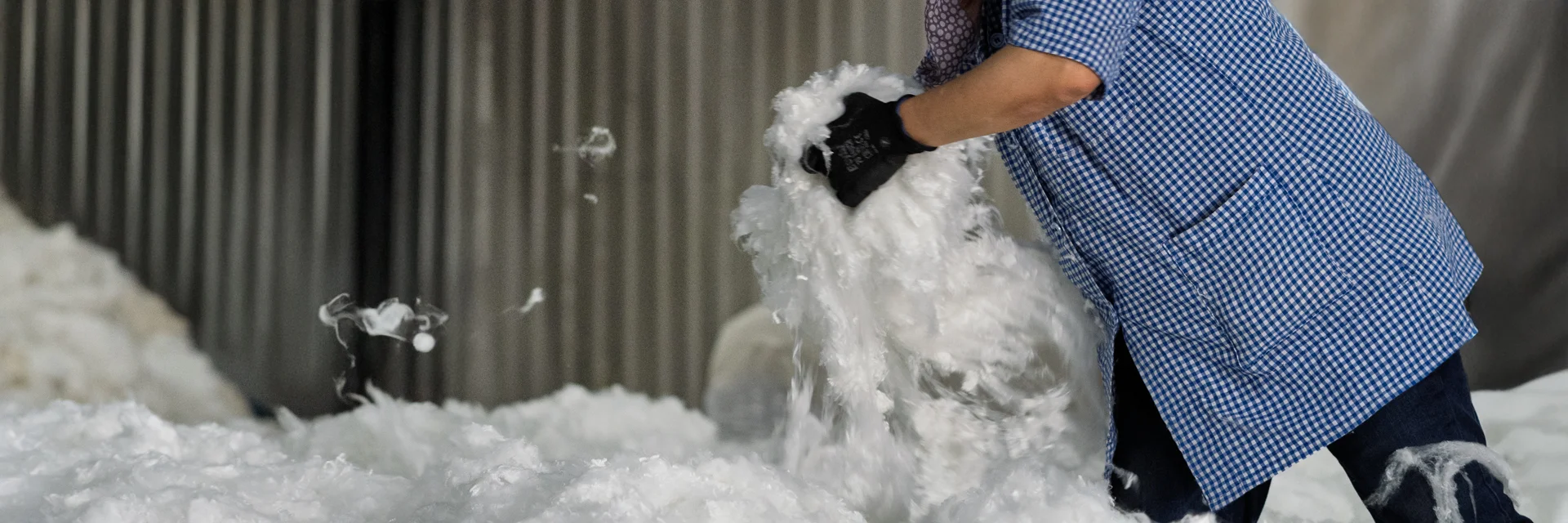
Yarn produced by returning textile waste to fibre and spinning it again. It reduces the need for virgin raw material.
Ring yarn
The classical spinning method. Produces a more even and stronger yarn than open-end.
rPET
Recycled polyester obtained from used PET bottles. rPET pique is not part of Sesli Tekstil's product range.
Tartan (check)
The classic pattern of colour bands crossing at right angles. It is built with yarn colours during weaving.
Handle
How a fabric feels to the touch — the perception of softness, body and smoothness.
TSE
The Turkish Standards Institution certificate. Frequently requested in public purchasing.
Three Commonly Confused Pairs
| Term | Confused with | Difference |
|---|---|---|
| Jacquard | In jacquard the pattern is built with yarn inside the weave; in printing it is transferred onto the surface | |
| Pique | Duvet cover | Pique is the product itself; a duvet cover is a case |
| Regenerated yarn | rPET | Regenerated yarn comes from textile waste; rPET from used PET bottles |
Sources and Standards
- Oeko-Tex Standard 100 — OEKO-TEX Association
- Global Recycled Standard (GRS) — Textile Exchange
- ISO 9001 · 14001 · 45001 — International Organization for Standardization
- TSE — Turkish Standards Institution
Related Reading
A technical question?
Let us clarify together what these terms mean for your product.